title

search slide
search slide
pages bottom
About Me FSA has been serving central and northern New Jersey since 1995. We design, install, and maintain: water gardens, water falls, aquariums, koi ponds, bogs, streams, wetlands, pondless water falls, landscape lighting. This Blog highlights our projects, techniques, and care for you to take home and use on your own pond. Enjoy!
  • Mgannon Now it wouldn't be much fun if we ALL di...
  • Mgannon Hey Zac, thanks for the comments and ins...
  • Zac I agree with you that aerators are the b...
  • Zac Herons are by far the worst preadators f...
  • Mgannon Cut up is preferred, julienne style if y...

NATURAL PREDATOR PROTECTION FOR PONDS

Ok, pond owners this is the time of year that we all have to start our vigilance and watch out for herons showing up at out pond. Late winter is always the time of year that the herons start making their patrols in search of that easy meal, of our beloved pets, from our ponds. We all get a bit complacent this time of year in checking our ponds but now is the time to start being a bit more aware of our ponds presence to local herons.

     When dealing with heron visits use all means possible as they are very smart birds. A great means of keeping away this pond predator is by use of natural means. Do I mean planting around your pond to limit access? Well, yes, but I also want to suggest something not so often considered in natural predator control. How about the fact that birds all happen to be very territorial. In the northeast United States and other parts a very common bird is the Blue Jay, who happens to be a VERY territorial little bugger, much to the backyard koi pond and water garden owner’s advantage.

     We’ve probably all seen at on time or another a mid-air battle between a group of little birds and a sole bigger bird. All the little birds swarm the bigger bird, dive bombing, picking at, feather nipping, head pecking, and chasing; not too mention if you listen, screaming at the bigger bird. These birds, although smaller, mean business and are usually very successful at removing the large invader from their territory. When one tunes in, the politics of the bird world, they pretty much are always chasing each other and trying to dominate territories.

     So what does all that fighting do for my pond? What does it do for your pond? Unfortunately this is really not about your pond so much as it is about setting up a desirable area for blue jays to come and nest and defend a territory in your yard, CLOSE to your pond. I am, by luck, fortunate enough to happen to have blue jays that nest in my yard, not because I had enticed them, but simply happened to be the blue jays choice.

     I have battled the herons for years now, but came to realize that when the heron was showing up at my pond, the blue jays nesting in my backyard were going absolutely nuts! Screaming like crazy, flashing from tree to tree to tree, screaming!, and blue jays might be small and pretty, but those birds have some lungs, and can really reach some decibels. I have to admit, it took me several times to realize that the reason they were going nuts is that a huge predator, the heron, which WILL prey on other birds, was right in their territory and the blue jays did not know or care that the heron was there for my fish!

     I have found the blue jays to be very effective indicators of something going wrong in my backyard, and when I hear them sounding off, I go running to see why my blue jays have gotten their feathers ruffled, and they usually are passing me some pretty good info, and I have thwarted several visits by my local heron thanks to my blue jays.

     So, yes, use all the means you can to keep the predators for taking your prized pond fish; but don’t be shy about relying on your neighborhood birds to help predator control too and they can be easily enticed to living right in your yard!

     Ironically, on a side note I have very much the same reaction to predatory herons in my yard as birds. I run from room to room screaming at the heron…

 blue-jay_gh

RAIN GARDEN CERTIFICATION

On February 18, 2010 I spent the day working on the first part of my Rain Garden Certification process through Rutgers University Extension. The first part of this process was spent doing class time. I was able to spend the day with several other candidates in a lecture hall meeting with and connecting with some of our areas top rain garden experts and professionals. Topics ranged from the basics of what is a rain garden to installation process, site selection, plants to use, benefits of rain gardens, regulations for rain gardens, as well as a panel of rain garden experts made available for us to field questions and an open exchange of ideas.

Rain gardens are an amazing approach and method to not only creating beautiful and functional landscapes, but they are an easy low maintenance way for home and business owners to practice conservation and to be good water stewards. For stormwater control, rain gardens will soon be seen in places we never thought of and installed in a way that you will only think you are looking at a pretty garden installation.

The second part of my rain garden certification process will take place in March when I will do a hands-on rain garden installation. Wish me luck, and please call me if you or anyone you kow is interested in installing a rain garden or would just like a bit of information.

Thanks for reading the LOVEYOURPOND blog!

     The LOVE YOUR POND blog is written by Mike Gannon of Full Service Aquatics. Mike is a professional pond builder and expert in the broad topics of fishkeeping and water gardening. Mike also produces THE POND HUNTER video series which can be viewed on Youtube. “In The Pursuit Of All Things Aquatic” the Pond Hunter videos provide how-to pond construction videos, pondumentaries, and videos of related interest. Mike resides in New Jersey with his wife and 2 daughters. To visit his website go to www.loveyourpond.com and visit The Pond Hunter at www.youtube.com/thepondhunter

KOI AND CHEERIOS

cheeriosThis morning I fed my koi Cheerios, yes you read that right, Cheerios. Like most mornings I went out to feed my guys before heading out for the day and realized that I was at my last handful of koi food and this was one hungry pond installation full of koi fish. The fistful of food I threw in disappeared right quick and my koi seemed to be giving me a look as if they were actually sizing me up as to whether I might make a palatable breakfast for them, should I happen to slip or accidentally get pulled into the pond by this group of otherwise unassuming pond fish.

     After seeing the look in their eyes my anxiety level rose a bit as I realized they got to have mo’ food. Since the local koi food store was not open at this early hour I knew I had to improvise to keep my pond full of fish satisfied, and the pressure was on. I quickly ransacked my kitchen, scrambled eggs? no. breakfast bar? no. last night’s meatloaf? definitely no. Cheerios? no. or maybe yes. YES, Cheerios, I had heard of other pond people who had given this iconic worldwide oaty breakfast staple to their fish and even claimed that the pond fish liked it, so why not my pond fish, don’t they deserve a good old fashioned breakfast of Cheerios? I had it forced upon me for most of my life…why not my koi too. Anyway, this box of Cheerios had been here since 2004 and it seemed half a decade later it was time to use it. Waste not want not.

     I went back out to my backyard pond installation, which is a professionally installed pond by Full Service Aquatics by the way, holding the box of cereal between myself and my koi so as to make my intentions apparent to my loving koi. I sat at the arbor, just out of reach of the vice like grip of my koi’s fins and tossed in a handful of those oaty treats. My koi eyed them suspiciously. One of my koi peered through the opening of a Cheerio at me with the menacing look of “if this aint’ good I will squeeze right through this oaty treat, and pull YOU right back through it into this pond and teach you what a hungry fish is capable of”. I shuddered to myself. Then…he ate one, then another ate one, suddenly the rush was on and they cleared those Cheerios that were bobbing around in my watergarden just a moment ago. I tossed in some more and those koi cleared the pond surface again with gusto and continued this until the idea of making a meal out of me was a distant memory.

     So the lesson here is; learn what other foods your koi will accept, you may be surprised what you can find in your cabinets and refrigerator that will do in a bind. Koi will enjoy a wide variety of foods beyond the pelleted formulas that we all tend to rely on. It can be a lot of fun watching your pond fish devour oranges, watermelon, spinach, chopped hard boiled eggs, even dry cat food; all of this in moderation of course, and who knows, maybe you won’t have to eat your next bowl of Cheerios all by yourself!

THE FROZEN POND

    Frozen ponds is a subject that of course only seems to pop up seasonally, like during winter…well of course, why worry about it at any other time of year? The problem I see again and again with many pond owners is a real misunderstanding of what is happening with their ponds during this season, and if the subject is not addressed quickly the season ends and if a pond is not frozen why talk about it. So NOW is the perfect time. Here in the northeast U.S. I’d guess just about everyone’s ponds are frozen if they have not taken the steps to de-ice their ponds. So, naturally this is the time everyone goes into panic mode about what to do with their iced over pond.

     Here is some, I hope, comforting information about frozen backyard fish ponds and watergardens. When a pond freezes over it forms what would best be described as an ice cap. This ice cap will generally extend from edge to edge of the pond, but it is not airtight and will still allow air flow. This seasonal stage of your pond can be very pretty and enjoyable IF you truly understand what is happening below that ice cap that is putting a barrier between you and your fish and plants.

     The primary customer concern with freezing ponds is how the fish that are below that ice cap are dealing with it. I have yet to get a distress phone call from a customer about how the ice is affecting their water lily, after 15+ years in the pond industry that phone call has not yet come. The distress phone calls are always about how the ice is affecting the fish. On the assumption that your pond is: an in-ground pond, constructed properly to a depth of 30+ inches, and fairly well managed during the year and is not ice capped with loads of decaying leaves, debris, or putrefied food below it, the following information will apply.

     Ponds freeze from the top down and RARELY freeze solid all the way through. Fish ABSOLUTELY DO NOT under any circumstances freeze into the ice and then thaw out during the spring to comeback to life. If a fish freezes it only has one outcome…death. I have customers swear their fish are frozen into the ice, but I personally assure all of you and them this is not the case. When you see a frozen pond it is only ice capped which will slow down the oxygen intake and ammonia release of the pond, but it does not stop it. In many ways a winter time ice cap for your pond is desirable. The ice cap on the pond does not actually even touch the water, and really acts as a fantastic form of protection from the harsh conditions of winter. Between the water and the ice is a pocket of air and below the air pocket is fresh unfrozen oxygen rich water. Very cold water carries large amounts of oxygen which our pond fish utilize during the frozen times and our aquatic plants still photosynthesize during the winter and create more oxygen for the fish.

     Do not EVER try to walk on your frozen pond for the obvious safety reasons. It is a good idea, however; to keep the pond cleared off of snow, try to use a long handled broom to clear snow as the noise of shoveling can be a bit much for the dormant fish. We still want to let light into the pond for our aquatic plants to do what they need to do, create oxygen. Breaking a hole in the ice is not a good idea as it stresses the fish, try quietly melting a hole in the ice if you need to. Recent studies do relate that the amount of oxygen that diffuses into pond water during the winter is very minimal, so those de-icers and aerators we all hook up are doing more of a job of degassing the pond of ammonia build up, rather than oxygenating a pond and quite honestly the floating de-icers really don’t do too much at all. Studies have actually proven that ponds that are ice capped and have dormant aquatic plants will have a rise in oxygen levels if left undisturbed. The stirring or circulating of an ice capped ponds water is not really a good thing to do, unless it is a very dirty pond and an emergency situation is on hand, otherwise leave the pond water alone and let nature do her thing.

     Pond aerators should be employed and placed into areas that maybe “dead zones” during the rest of the season. Aerators should keep an open area most of the time but even when they get frozen over and you have an “ice dome” those aerators are still degassing the pond and moving that pocket of air in between the pond water and the ice cap.

     Fish will remain dormant, or in stupor mode, during this time and many fish experts agree that this dormant period, for koi especially, is important and koi have evolved to endure these conditions. At the end of winter when spring returns and we can start so see our fish again, the will surely be a bit thinner but that is normal and shows that they were able to handle the winter time and utilized the fat reserves they build up in preparation for the cold spells. It also gives you the opportunity to enjoy feeding them and getting nice and rotund again during the rest of the season.

     Frozen ice capped ponds should be as relaxing to look at as your pond is at any other time of the year and hopefully with some of this information you can now rest easy and know that your fish will come through winter after winter without any issues. Keep nutrient load low, keep fish population controlled, provide a simple aerator, and don’t mess too much with your pond and you and your pond will be fine. It is a short seasonal period of  freezing, enjoy the short lived beauty of an iced over pond because the spring will be here before you know it!

DE-ICING YOUR POND PT.2

     Now you’ve chosen what type of de-icer you plan to use it’s a good idea to know how to install them. It is best to place the de-icer in your pond at the time of winterizing your pond. You may not necessarily have to have it plugged in but it is staged and ready to go. The floating de-icer is best installed away from the edge of the pond as far towards the middle of pond as the cord will allow, if you have a larger pond you will want ot consider using multiple units. Many floating pond de-icers come with attachments to keep the heating element from coming in contact with pond edging or equipment.froz pond

     The submerged aquatic de-icer is best placed at about the mid-depth range of the pond. Placing it too high can create problems and possible leaks if the winter weather gets too severe, and/or a very splashy display; and placing it too low will circulate the bottom water of the pond to the top which can cause the pond to get too cold and stress or weaken the fish in your pond, it also makes it a bit more difficult to get to if you need to service the pump.

     The aerator de-icer should be installed with the air diffusers also at about mid depth in the pond. Pond aerators can be purchased with multiple outputs, if your model is equipped this way I suggest utilizing multiple points of aeration in the pond. The airlines leading to the diffusers will most likely freeze into the ice in very cold conditions and typically will not represent a problem.

     If you are installing your de-icer AFTER the ice has come take some precautions when working around the iced over pond. DO NOT TRY TO STEP ON YOUR POND TO GET A UNIT OUT TOWARDS CENTER, at this point you need to settle for close to shore for all installations. Do not try to break or chop a hole in the ice, not only is ice of only 2” thick VERY difficult to break open, but the noise created by the chopping, pounding, and cutting is very stressful to your koi and pond fish who are now in a deep winter stupor. The term stupor is used to describe the state of being in which pond fish basically shut down, are extremely quiet, and do not move. The sudden noises will take them out of stupor into panic which is not a good transition for any fish to make during deep winter giving your pond fish and koi great stress and possible death.

     Best approach is to use hot water and slowly melt a hole into the ice until it is open enough to install which ever type of pond de-icer you intend to use. The hot water approach is very effective, and very quiet. Keep an eye pond your pond during the cold spells and snaps and react accordingly. Good luck.

The LOVE YOUR POND blog is written by Mike Gannon of Full Service Aquatics. Mike is a professional pond builder and expert in the broad topics of fishkeeping and water gardening. Mike also produces THE POND HUNTER video series which can be viewed on Youtube. “In The Pursuit Of All Things Aquatic” the Pond Hunter videos provide how-to pond construction videos, pondumentaries, and videos of related interest. Mike resides in New Jersey with his wife and 2 daughters. To visit his website go to www.loveyourpond.com and visit The Pond Hunter at www.youtube.com/thepondhunter

DE-ICING YOUR POND

frozen pond 2It’s that time of year here in the Northeast US that pond owners need to keep an eye on their ponds. Typically when January hits, this area will receive some sustained below freezing weather that will surely create ice on unheated ponds. Pond heaters are a pretty costly approach to controlling temperatures in the pond but they do work well. I usually recommend to my pond customers that the use of at least a de-icer should be employed by those who are not able to swing the costs of a pond heating system; this recommendation applies to pretty much ALL my customers, myself included.


     Pond heating system vs. de-icer…..what’s the difference?


     A pond heating system will actually heat the entire body of water, usually to about 52+ degrees. It is a large and pricey piece of equipment and usually used by those who are aficionados and breeders of koi.

     The de-icer is meant to just keep a hole in the icy covering of a frozen pond to allow for the escape of ammonia from the pond, which escapes as a gas; and for the introduction of oxygen to the pond. De-icers can range from floating disc heaters, to submerged water pumps with a strong upward flow to the surface of the pond, or the use of an aerator. The goal of any of these is to keep an area of the ice open! If your floating disc is stuck in the ice it is time for a new one.

     My personal preference for a de-icer is the pond aerator; by using an aerator you are circulating the water from bottom to top very slowly, this does not create any dramatic or sudden changes in water conditions. The bubbles that are bursting at the surface are releasing ammonia from the pond while at the same time agitating the surface of the pond to allow oxygen to enter back into the pond and keep a nice opening in the pond. The aerator is also the most economical piece of equipment to use as well, from purchase price to cost of running the pump it makes the most sense to me.

     The submerged water pump works well but still will allow for complete formation of ice over the surface of the pond, and often times will move water too quickly from bottom to top which can increase the risk of supercooling your pond, or water loss during winter months.

     The floating de-icer usually works well, but provides no circulation benefit, and does have a higher failure rate than the others. Also, the cost to run a floating de-icer, which uses about 1250 watts, can be as much as $30.00-$40.00 monthly…ouch!

     Any submerged de-icer should not actually be installed at the deepest portion of the pond but about 10” below the surface of the water would be ideal. The floating de-icer should FLOAT!!


     OK, pond owners keep your eyes peeled and don’t forget to check your pond this time of year, and enjoy it, take some winter photos; a pond with snow and ice around it is really a beautiful sight!


The LOVE YOUR POND blog is written by Mike Gannon of Full Service Aquatics. Mike is a professional pond builder and expert in the broad topics of fishkeeping and water gardening. Mike also produces THE POND HUNTER video series which can be viewed on Youtube. “In The Pursuit Of All Things Aquatic” the Pond Hunter videos provide how-to pond construction videos, pondumentaries, and videos of related interest. Mike resides in New Jersey with his wife and 2 daughters. To visit his website go to www.loveyourpond.com and visit The Pond Hunter at www.youtube.com/thepondhunter

POND SAFETY AWARENESS

Pond safety is a pretty tough topic to be able to come to any one solution as to what would be definite guidelines for safety. The difficulty in defining this matter comes from the fact that there are so many types of ponds, waterfalls, koi ponds, fountains, water features, and streams. Each one has its own safety issues that need to be addressed. Discussing some good general guidelines for pond safety should help any reader fine tune some pond safety guidelines for your particular pond installation. Safety is an issue/concern that is often expressed by people who are in the pond market looking at doing a constructed pond installation. Pond installation safety can be addressed regionally as well in that guidelines, regulations and codes of safety will vary from state to state or even town to town; a New Jersey pond installation will not be looked at as the same pond if it is a Pennsylvania pond installation.

     In general it should be recognized that any body of water, regardless of the size, has the potential to cause a hazard. For this discussion we’ll try to keep the safety discussion in the realm of falling into or drowning. As part of our services for a pond installation we do a pond orientation for the new pond owner so they understand exactly what was installed, where it is, and how it works. We also make sure to point out the safety features of any pond installation. The shelves in a pond, for example, are not solely for housing aquatic plants, they are meant to function as “entry or exit steps” within the pond to avoid any sudden drops in depth, and this should be taught to the pond owners and any children that may come in contact with the water feature. It should be pointed out where is the best entry and exit for any given pond, the deeper areas should be pointed out as well as the shallows. The perimeter of the pond should be explored with the pond owners and kids to point out which areas are best for stepping on, sitting on, or standing; and which areas cannot be used for traffic. It is a good idea to even allow a supervised dip in the pond to familiarize oneself on how to navigate inside the pond.

     All areas where equipment is housed should be pointed out and explained and these areas are best left to themselves apart from maintenance of the systems. A GFCI outlet should be used with all pond equipment and all equipment that needs power should be inspected frequently, especially after extreme weather, for its condition and to make sure all connections are tight and protected, DO NOT assume that once you plug in your system it is a walk away type of deal, check frequently the condition of your equipment, you never know when that cute little chipmunk has decided to chew a bit on the cord to your pump, which can represent a safety issue.

Finally, whether decorative or functional, some sort of floatation device should be kept near and handy to any pond installation, if you ever need it you’ll be glad to have it on hand. For larger ponds a life preserver and rope should be close to shore. Safety is an extensive topic that will be visited again, but use your head, take the time to look around to identify what could be a liability to the safety of your constructed water garden, koi pond, waterfall, or fish pond. Consulting with a pond professional who can give you insight into safety factors is a worthwhile investment, call Full Service Aquatics today to schedule a safety consultation for your NJ pond installation today.

The LOVE YOUR POND blog is written by Mike Gannon of Full Service Aquatics. Mike is a professional pond builder and expert in the broad topics of fishkeeping and water gardening. Mike also produces THE POND HUNTER video series which can be viewed on Youtube. “In The Pursuit Of All Things Aquatic” the Pond Hunter videos provide how-to pond construction videos, pondumentaries, and videos of related interest. Mike resides in New Jersey with his wife and 2 daughters. To visit his website go to www.loveyourpond.com and visit The Pond Hunter at www.youtube.com/thepondhunter.

PONDS AND COFFEE

     I have a confession to make; I use pond water to make my coffee. Ok, I’m kidding, not only would my Pond Princess (wife) kick me to the curb if I still did that, more importantly the coffee would taste funky.

     This morning I sat by my pond and drank a cup of coffee while I tossed some breakfast pellets to my lovely koi fish. I was still in my pajamas while doing this and it is not the first time nor will it be the last time I do this. Drinking coffee by my pond is one of the most relaxing things I do. Drinking coffee by my pond is greatly missed in those winter months, when I will sit by my dining room window looking out at my pond while drinking coffee, not quite as relaxing but a relished activity of mine all the same.

     The next time you have the chance OR just make the chance, take the time to sit with a cup of Joe by the pond and enjoy it. Slow down for a few minutes, enjoy your koi fish, your water garden, and your waterfall with a nice hot cup of coffee, you’ll thank me.

     Coffee by the pond…..c’mon what are you waiting for.

A WORD ON POND EXCAVATION

Costanzo Project (4)     Pond digging! That seems to be what most call this activity. I call it pond excavation, and as a professional pond excavator that seems to sound so much better to me.

     At some point every pond builder has heard, and will hear again, the suggestion from a potential customer, usually while in the negotiating process; “I friend of mine has a backhoe and they will dig the hole, can you do all the rest after them to cut costs a bit?

     This approach can seem reasonable, but to a pond builder it is a challenge to really explain why it is in every way better to have a pond professional do what they do from beginning to end. Pond building should not be a shared project. When I hear this suggestion I already know that if someone else digs the hole, they are doing exactly that….diggin’ a hole. This in turn means when my phase of the project comes up I will have to do a whole lot of fixing problems with levels and depths, fixing problems with the shape, fixing problems with structural integrity, sometimes even re-filling areas; which in turn actually will drive up the costs of any project. Anybody can dig a hole, anybody with a backhoe can dig a hole quick and cheap, but not anybody can properly excavate a pond or water garden. So, why is this?

     From the customer point of view it just makes plain economic sense on the surface of it, but dig a bit deeper, and the flaws of this thinking start to get uncovered. From the pond contractors point of view it can be looked at this way: probably the most important part of any pond installation project is the excavation. I prefer the term excavation to digging because digging conjures up an image of hapless, rushed, unsophisticated, removal of the material called dirt. Excavation however; entails something much more sophisticated. Excavation requires thought, planning, and strategy. Excavation allows for intelligent use of the material being removed. When excavating one will encounter vastly different layers of material which can be utilized later in the project, and not just removed wholesale. Most importantly the work of excavating is the beginning process of creating a unique, artistic, and beautiful water feature. Pond excavation is the time that depths, shapes, shelves, tunnels, caves, and planting areas are created. Excavation is when the final depth of the pond needs to be addressed and creating utility depressions for future cleanout pits, and planting pockets need to be made.

     A good experienced pond builder wants their ponds to look good inside and outside; something the customer will appreciate more and more as they go and see others’ “dug out” ponds, as compared to their professionally excavated pond. The inside of a pond installation needs to look good, it needs to have style! The excavation process allow the pond contractor to be familiar with the lay of the land and make adjustments around the pond to deal with issues such as drainage, and to help take advantage of landscape subtleties to their best advantage when the final product is complete. During excavation filter systems are planned for and excavated for, streams and waterfalls and how they can flow and connect with the most natural results are prepared. The excavation process is so much more than just digging the hole; the pond excavation is the heart of the project and gives any good pond builder the opportunity to make the most beautiful water feature possible, rather than trying to make something out of someone else’s hole in the ground.

     In the old days of pond building which was almost exclusively DIY, the approach was: dig a hole, slap in a liner, fill with water, weigh down edge with rock, add plants. But, oh, how those days are gone! You now have access to talented, experienced, creative pond builders who will most likely surpass your expectations when building your water feature. Pond specialists who are efficient, well-organized, and passionate about what they do, and it is all they do! Take advantage of that, you as a customer have a valuable resource at hand that can greatly enhance not only the enjoyment of the pond structure, but your overall experience in pond keeping. Ponder that!!

The LOVE YOUR POND blog is written by Mike Gannon of Full Service Aquatics. Mike is a professional pond builder and expert in the broad topics of fishkeeping and water gardening. Mike also produces THE POND HUNTER video series which can be viewed on Youtube. “In The Pursuit Of All Things Aquatic” the Pond Hunter videos provide how-to pond construction videos, pondumentaries, and videos of related interest. Mike resides in New Jersey with his wife and 2 daughters. To visit his website go to www.loveyourpond.com and visit The Pond Hunter at www.youtube.com/thepondhunter.

FEEDING YOUR POND FISH

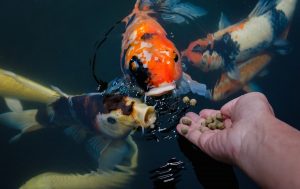
Jul 03 2008 - VID00142_5It is drawing near the end of summer and it is time to make sure that your koi, goldfish, and pond fish are getting all the food that they care to enjoy right now! This time of year is an excellent time as a pond owner to take advantage of their voracious appetites and let them build the fat reserves they’ll need for those winter months when pond fish no longer are taking in sustenance. It is a good time to be able to interact with your koi fish as well, if you’re interested in hand feeding your koi this is a great time to give that a try.

     Be careful with your feedings though it is easy to fall into the trap of over feeding your fish which can really drag down your pond or watergarden’s water quality and clarity. Remember this: fish do not overeat, WE overfeed. That excess food just breaks down, creating high nutrient levels and clogging our pond’s filters! So while your fish are still on summer staple foods…let ‘em eat! As the weather cools switch over to the “Fall Blend” fish diet of your choice and feed your koi and pond fish until water temperatures settle at around 52 degrees and discontinue feedings at that time.

     Let your koi, goldfish and pond fish settle down for those winter months and before you know it, pond season will be back

The LOVE YOUR POND blog is written by Mike Gannon of Full Service Aquatics. Mike is a professional pond builder and expert in the broad topics of fishkeeping and water gardening. Mike also produces THE POND HUNTER video series which can be viewed on Youtube. “In The Pursuit Of All Things Aquatic” the Pond Hunter videos provide how-to pond construction videos, pondumentaries, and videos of related interest. Mike resides in New Jersey with his wife and 2 daughters. To visit his website go to www.loveyourpond.com and visit The Pond Hunter at www.youtube.com/thepondhunter.

« Previous Entries