
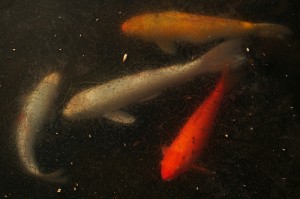
THE BIG QUESTION:
What happens to koi and goldfish during the winter months? This is a common question and concern that many pond keepers have. Warm weather is obviously the best time to enjoy koi and goldfish keeping. During this time koi and goldfish are active, lively, and highly visible. Many koi and goldfish become downright interactive with pond keepers. Koi and goldfish will follow the pond keeper around the pond. They will even stick their faces out and practically climb out of the pond to celebrate feeding time. During this time we know is exactly what is going on with our fish. A quick peek in the pond tells us everything.
CHILLING OUT:
Then the cold weather sets in. Snow, ice, shorter days, and more indoor time leads to our slowly losing our ability to see what’s happening with our pond fish. These conditions can last for many months depending on your location. Once the ice and snow come; well, we lose touch with our fish. So what’s going on underneath those layers of ice and snow? What are our fish up to? Are they missing us? To most pond keepers this time of year is simply a mystery. We wait, sometimes with great anxiety, for the spring thaw so we can once again connect with our koi and goldfish. What’s going on under the ice and snow?
THE COLD HARD FACTS:
Here are some facts about Koi and goldfish. Koi and goldfish are poikilothermic animals, a fancy way of saying cold-blooded. This basically means that their body temperature is regulated by the surrounding temperature of the water. In turn, their body functions respond and change according to the water temperature. The activity level slows down. They tend to keep themselves concealed when concealment is available. Rate of metabolism for koi and goldfish is greatly reduced during low water temperatures, especially below 50F. This is why they do not feed during the cold periods, when water temperatures drop and stay below 55F. Koi go into a state of torpor.
Torpor is not quite full hibernation, it is of a shorter duration than hibernation. Otherwise it is a very similar state of being: lower body temperature, reduced heart rate, slowed metabolism, slow reaction times, reduced breathing rate and primary body functions. Torpor allows the animal to save the energy that would otherwise be needed for higher levels of activity. Torpor can take some time for koi and goldfish to snap out of as well. If torpor needs to be broken try to do it with finesse. Many experts say that because koi and pond fish are cold water fish (non-tropical) they actually benefit from a cold period. However; prolonged and extended cold spells, and dark, are not good for them. During these prolonged cold spells they run the risk of their immune systems greatly weakening or shutting down.
WHAT ARE THEY DOING??
In short our fish are not up to too much under the ice and snow, sorry, but keep reading anyway. Our koi and goldfish not being up to too much is an interesting behavior, considering how lively they are throughout the rest of the year. For the most part they sit on the bottom of the pond in the “warmest” pocket of water they can find. During winter months the warmer water is on the bottom of the pond. During warmer months its inverses with colder water at bottom of pond and warmer water up top. I have often seen my koi lined up next to each other, evenly spaced, facing the same direction; as if they were in a parking lot! This funny behavior that may lead a pond keeper to think koi and goldfish are huddled together to share body heat; but koi are poikilothermic, so no. This behavior is probably a way to fit as many koi into that pocket of warm water as possible. In larger warm areas you’d probably see a more random formation of the koi, some facing this way and others facing that way.
There will be some activity but this is all temperature dependent. When water temperatures are between 45F – 55F koi and goldfish will still slowly mill around in the pond. They will still take some time sunning themselves when conditions allow as well. Once water temperatutes dip below 45F they will remain pretty still, even on sunny days. Although we do not and should not be feeding doesn’t mean that there is zero sustenance being taken in. This time of year koi and goldfish will still casually scrape the highly nutritious algae from rock growth below water for a bit of calories and energy. Because of the state of being in torpor it is a very good idea to keep things as calm as possible around the pond.
DON’T BE LEFT OUT IN THE COLD:
Keep an area of ice open as much as possible by using a floating or sinking de-icer and/or an aerator. This open area in the ice will allow gases to escape the pond and oxygen to get in more efficiently. If you need to open the ice in the pond find a quiet way to do it like using boiling water to open a hole if the ice is thin enough. Don’t chop or break ice open with a pick ax or hammer! Most pond pond professionals will use a hand held drill with a hole saw to open ice. This approach is actually pretty quiet compared to other methods. If your a pond keeper the hole saw is a great tool to have. Some people add salt to their ponds. I personally am not a practitioner of adding salt unless it is for treatment purposes. If you do add salt to your pond you should dilute your salt levels during cold winter months. Higher salinity can make your pond water’s freezing point drop to below 32F which can kill your fish. Generally speaking you should not let your pond water’s temperature drop below 34F. Temperatures below 34F will allow ice crystals to form on the gills of your koi and goldfish, which can kill them, so watch the temperatures if you live in an area of extreme winter temperatures.
THERE IS A NIP IN THE AIR:
Really. Winter is still prime time for predators of our koi. Torpor make our koi and goldfish very easy targets. Some brutal predators like mink and the great blue heron have no issue hunting our frozen ponds. When conditions allow try to keep a count of your koi and goldfish. It would be prudent to set up predator controls for your pond.
PLAY IT COOL:
If a pond was cleaned and prepped prior to those cold dark winter months, then worry not, koi and pond fish should do just fine. Like mentioned the koi and goldfish in your pond do not DO much during the winter months. Spring will be here soon enough and your fish will start again with their antics and amusing behavior. But for now you have a better idea of what is happening out there under the ice and snow, and you are not missing out on any party. If only we all could share that state of torpor and wake again when the spring has sprung!
All copyrights to this material belong to Mike Gannon.
Hi, is the image ‘koi-under-ice’ copyrighted? I am aking as I am doing a koi fish project and we can only use copyright free images.
Thank you
Eleanor
Hello Eleanor, that photo is not likely copyrighted. I too try to use non copyright images, but I’d doa google search just to be sure!! thanks for reading the blog. Mike
Hello Mike,
Someone gave my son pond fish as a present, and because we are renting at the place we are living, there is no space for the pond fish to be inside in a tank. So, I have an idea of using a large planter that is approximately 40″ (plus) diameter to use as an above ground pond. Would a planter serve as an adequate pond for pond fish?
Hello Ginger,
Thanks for getting in touch! Before saying that the planter will work, it needs to be considered what material the planter is made of. What type of pond fish are we talking about? What type of climate do you live in and will this be a year round housing for the fish? I have seen many patio ponds that have fish in them but cannot function year round because of cold weather conditions, or even very hot conditions. In all I’d say it is not the most ideal situation for fish keeping, but not impossible either as long as the conditions are right.
Mike
I am a biology teacher considering an environmental club project to remediate an algae filled pond in a local park (central NJ) by seeding with duckweed and using Koi to feed on it. Do you think koi are hardy enough to survive winters here untended? I don’t know how deep it is, but that is one of the things the kids can investigate, I would be very grateful if you could give me some pointers.
Hello Karen, that sounds like a great project. I’d need a bit more info to give you good advice, but generally speaking the koi will be winter hardy. Feel free to give me a call, I am also based in NJ and would love to discuss your project. Call Mike at 908 277 6000!
Hello,
I have a pond which is very deep (about 4 ft) but last year in Norfolk it was so very cold and in the early spring two of my lovely fish died, they were quite old though so I am not sure f they simply reached the end of their life or died because they just couldn’t cope with the freezing temperatures. They have lots of shelter as I have used square sley type material drain pipes …(have used them for year and the fish love to hide in them and swim through them!) The water never completely freezes over as I keep the pump running which powers the water fall too so there are always two areas which are ice free, I am however still a bit concerned about the winter months this year, should I cover part of the pond with bubble wrap or something similar to maintain an element of heat?
Looking forward to hearing from you,
Kind regards,
Eve
Hi Eve, I don’t think that it is necessarily an issue of higher winter temps that you need to have. I think with typical de-icer/aerator equipment during winter you should do just fine; and the many years of trouble free winters would support that. I cannot say why your fish passed but I don’t see reason to insulate the pond any more. Be sure you give your pond and filters a good cleaning before winter hits, and add more aeration if you need it! Mike
we recently bought a house, and in the backyard there is a koi pond and there are maybe 10-15 fish in the pond. i’ve been reading on what i should do, but i’m still not 100% on what steps i need to take to get it ready for cold weather. it has a waterfall and a hand built filter system. i do have a heating rock to put in the pond. i wasn’t sure if there were any chemicals or anything like that that i needed to put into the pond. i know that they can survive the winter if the pond is prep properly. wondering if you can give me some helpful hints.
thanks so much
brittany
Hey Brittany,
thanks for getting in touch! Some systems can run year round, others need to be shut down. You can use cold weather food for your fish and feed until late October typically, and you can also use a cold water beneficial bacteria treatment during winter months. If you search on the LOVEYOURPOND blog a bit you will find tons fo great info on how to handle your pond during the winter and how to prepare your pond for those winter months too. Try using the search function for what ever questions you may have and you’ll likely find an answer! Thanks Mike
Hi I live in California and the current temperature is about 82 degrees. I cleaned my koi pond and I think I may have inadvertently woken the koi from their Torpor state. The koi are back in the cleaner pond but are all at the bottoms and lifeless. I can’t tell whether they are hibernating or dead 🙁 . Any way to tell if I am an accidental mass murderer or not?
I am hoping for the best for your fish Mike. It should not take too long to know if they are dead or not unfortunately. If the temperature is 82 however; I don’t think your fish would be in a state of torpor. Hoping for the best! Mike
I have a small pond in Wisconsin. It’s about 3 ft in diameter, and 20 in deep at deepest. It has hardy lillies, and 3 goldfish – each about 3-4 inches long. I was going to bring the fish in for the winter and keep them each in a fishbowl. Problem is I can’t find them to move them to a fishbowl. Water is getting colder – I estimate it to be between 40 and 50. I’m afraid to leave them all winter, as the pond may freeze solid except for the deepest which may not be enough water to sustain them.
Hey Dave, it can get pretty cold in your area. I’d recommend trying to bring in the fish for the winter based on the size of the pond that you are describing. If you can’t then its a good idea to put in a de-icer or aerator. Let me know how you do! Mike
I live in Central Wisconsin with a 150 to 200 gallon pond, with a depth of 19 inches. Should I try to heat and aerate this pond, to over winter the fish? Thanks, Scott.
Hey Scott, yes I’d recommend aerating and de-icing your pond during the winter months. Mike
We have 150 to 200 gallon Koi pond about 19 inches deep and live in Central Wisconsin. Should I spend time and efforts trying to over winter my koi or will my pond still freeze solid?
we took our fish out our pond and put them into fish tank into are house for the winter but they’re slowly dying did we take them out too late we had our first snow storm the snow melted and thenwe put in our house in the fish tankdo they need bubbleshopefully you get back to me as soon as you can so I know if we did something wrong before they all die my little girls are sad about it
Thank you crystal j
Hi Crystal, I’m sorry to hear that you lost fish. I don’t think that bringing your fish in would have made them die unless they were not acclimated correctly. I am guessing that perhaps there was an ammonia spike in the new water and that may have killed your fish, but I am only guessing because there is alot I don’t know about the situation. Sorry again! Mike
Question:
My 2800 gal pond with waterfall with 14″ curtain pushing only 2000 GPH pump and my water is getting a white tent like an algae bloom in this cold weather, filters are clean, but, with a little sludge on the bottom (got behind due to wife on HOSPICE) Have 8 Koi about 7-8″, all readings seems A -OK or within range. Have been a Koi Keeper for 3 years
and lost two beautiful Koi today. White tent of water is telling me what?
KoiWrangler, Dallas
I live in Danville, CA and this winter is unusual here in the SF Bay inland suburb temp has fallen to 20 degree F for a few days now. I see their gills moving. The two oldest are at least 30 years old, I inherited them 12 years ago and the prior owner could not recall exactly when he put in the pond so this is the estimate; they were elderly and he said they can live to 100 years! They are huddled together; they always hang out together like a married couple and sleep next to each other their “snouts” inside the where the UV filter is.. One of the larger ones that is by itself and is about 5 years old and almost matches them in size already black and orange with fancy tail – obviously I am no expert! I also have smaller ones that I received as a gift from the person who used to service my pond before he moved to Florida. This cold snap has lasted so far 5 nights with last night being the coldest and will probably last another two then go back to the 60s in the day. The water has a lot of foam but no ice. Is there anything that I should do? The waterfall is running. I have not fed them in a week. I typically feed them once week in the winter here.a small quantity of food. I was told to change the UV lights every other year. I do not have a new koi pond person He cleaned out and drained the pond every year and scrubbed it. I doubt most people will do that. What is the typical maintenance routine and charge? I have a pond filter, modern. that he installed a few years ago and a waterfall that is currently running. Basically I buy shrimp meal food from an installer of koi ponds from Southern California in bulk that i met on eBay for a very good price I have about 11 fish now. When I got the pond with the house in 1999 there were 40 fish including gold fish but something happened insecticide by a careless gardner not sure so only the largest two survived. a very sad day. I bought the one I described I call Barbie because it is so beautiful from Hawaii during the recession and one from North Carolina that really looked like common carp that died and grew so fast just one day floated to the top I thought that koi floated to the top when dead not stayed at the bottom. All those that died were at the top so I was surprised that you told the other California person that he would find if the fish at the bottom were dead. I have seen 38 die excluding Mr. North Carolina. One thing I learned is that when we had an island in the middle we could not have small koi the birds ate them and Loi the person who took such good care of my pond told me to remove it because the birds may have used it to “fish” and sure enough, after that for the first time I had small fish that survived! One time I was surprised to see a stork on my pond at 6 :AM that must have escaped from the Oakland Zoo. I thought a small aircraft was over my pond and I screamed! Since they are only in the Gulf of Mexico, it must have come from the zoo! Luckily I saw it.
The former owner had blocks of salt that they used for the Koi and all sorts of medicine but none of that has been necessary. Any comments would be appreciated since I am not expert but am quite fond of my fish. I work out of my house and they take me outside. I pull out the leaves manually and spend some time out there and also clean out the filter rinse, backwash at least once a week. Anything else I should be doing? We have algae now., more than before on the rocks. I hate using the chemicals the fish do not appear to like them.
I have a 250 gal pond I put a few goldfish in. Every year the resident hawk gets them. My last set has lasted almost 3 years! Yeah. It is January in Atlanta and cold, not freezing. Currently one of the large fish is lying on the bottom looking dead. I went to remove him and he moved. I figured he is a goner. Then, 3 days later, he hadn’t moved and is on the bottom under some leaves. I went to remove him again, yikes, still alive. I guess he might live, I thought it was a swim bladder issue. this behavior is bizarre and no where on the web can I find this as normal. They have 14 babies I plan to give away this spring to the local kids. Too many fish for this pond. Thanks for the article.
Hi, I moved into an old home approximately one year ago and inherited a pond with three koi and three goldfish. Since then my wife and I have done everything we thought possible to keep our pond healthy (we have a filtration system, pump, waterfall, we purchased a new deicer, feed them above 45º-50º, add small amounts of PH balance occasionally, etc) but unfortunately two of the three koi died within one day of each other this February. The third one is currently lying on its side and it looks like he’s not going to make it either. Several days ago I thought it was dead but when I went to lift him out with the net he flapped slightly. I went back again this afternoon and it appears to still be hanging on. I’m scratching my head over this because the three goldfish appear to be doing well.
I have a few questions:
1. Is my fish dying or is it hibernating? It doesn’t appear to be hibernating/sleeping since it’s on it’s side and very weak when it flapped.
2. Is there anything I can do to help bring it back to health?
Please let me know. Thanks.
Hello, thanks for getting in touch. I’m very sorry to hear about your fish loss. The remaining koi sounds like it is in a state of stress, not hibernation (or torpor, as it is called with fish!) The smaller fish may not be stressed mostly because their body mass is much smaller and changes in environmental conditions are tolerated better. It is very difficult for me to say exactly why you lost your fish without alot more information; however since you are a new pond owner you should know that fish loss is not a typical problem. I believe it must be an environmental issue given the proximity in time that the other fish had died, and probably not necessarily disease related.
I would add a bit of pond salt to a therapeutic level, which is about 1/2# salt per 100 gallons. You can use solar salt that is also used for water softeners to save a bit of money, or just buy “pond salt” its the same thing. Also add some additional aeration, then wait and see how the koi does. Don’t bother it or poke at it, just give it time; it will either recover slowly or …not.
Good luck, and if you need anything else just let me know!
Mike
Thank you Mike for your reply. This is very helpful to read. Sadly, all three koi were lost. Your tips are useful regardless. We’ll know for next time and hopefully be better prepared.
-mark-
[…] Pond fish virtually hibernate in the winter months because their metabolism is controlled by the temperature of the water. This means that you should start reducing the amount of food they are given as the weather gets colder. You can stop feeding them completely when the temperature drops below 4oC. […]
Hey, thanks for the comment!
Hi, I have 4 very small koi fish ( about 4 inches) for a couple of months and they seemed to be doing well – the the weather dropped sharply (late sept.) and they have disappeared and are not eating – it is only about 55 degrees here in wash. d.c. , do you think that they are just getting ready for winter and—will they make it is about 5ft. x 3 ft. above ground cement pond – there is prob- thanks ably about 20 inches deep water
Hello Joyce,
above ground ponds do tend to have some issues when it comes to temperature control and they get pretty cold. Typically at 55F or less fish will stop eating or have very decreased appetites so given the water temps I am not surprised they do not want to eat. If we get any more warm spells offer them a bit of food and by November your feeding will mostly stop until spring. -Mike
Hello,
I live in Albany, NY and have a pond that is 2 ft deep. I have one goldfish that I put in this summer. He’s gotten bigger and seems to be doing well. Do I need to bring him in for the winter, given the shallow depth of the water? The pond is roughly 5 ft long, 2-3 ft wide and again, 2 ft deep. Thanks in advance!
Hi Anna, in general 2 ft is a sufficient depth to overwinter your fish outdoors. All of the ponds we build are at least 2ft deep for that reason. In extreme weather, like extended periods of time in single digit cold weather, you need to be careful. you should always add a de-icer for the winter months and an aerator will go a long way to ensure your fish do well during the colder months. Thanks for reading and commenting! -Mike
Dear Mike,
My name is Eli and I reside in Philadelphia, PA. This Spring we installed one of those premade plastic black ponds. Its on the small scale I would say more like the size of a bathtub. Not sure exactly how many gallons, maybe 60??? Anyway, we got some tiny and relatively small pond fish there that were thriving finally in the past few months. Its already brutally cold and windy here (especially yesterday) but although its already November Philly is expecting a climb of temperatures that will reach the 60’s and maybe even the low 70’s but I expect it to be isolated and more rare occurance. It is more than likely that we will see a steady drop of temperatures to below freezing and that snow and ice will come out way for prolonged period of time. Last winter (2013 into 2014) was very brutal so much so that the three hardy windmill palms I ordered from Florida seem dead as new frons did not form and all we got is the trunk, which I still refuse to dig out (I would appreciate advise w that, if you know anything). The special salt we added during the summer and fall once a month did not change anything for these poor three once beautiful 5 to 6 feet so called hardy palms that cost too much money I barely had)-; Anyhow, so I don’t want something similar to happen to my beautiful pond fish. I have a pump inside the water and a filter w UV light stationed just outside the pond both connected to an electric outlet. The waterfall seem to be very slow compare to before. I thought maybe because they fall on stones we put and don’t splash the pond itself from high above… or perhaps its an issue w the filter needing some cleaning, although it is new and installed in late summer, I would say. We took the pump out one day and applied water to its holes with pressure in order to “clean” it outside the pond. Then we placed it back. The waterfall we shut every evening since the spring or summer when it began working with this new pond. It is surrounded by rocks and special plants all around. In the water there is green submerged plant I bought at the pet store. Hopefully it will survive the winter though the bamboo we will probably take indoors. In the morning, we use the remote control to restart the waterfall. We collect rainwater which we add to the pond whenever it loses water. Sometimes days and weeks go by without major water lose, but one time we had 70% of the water suddenly gone. It scares me, and I wonder if its possible that all the water will be lost during the winter, and if we should add more water during the winter. Also, if temp will be in the 60’s or 70’s again, should we feed them. We have not stopped the feeding yet though during cold days the fish swim below and mostly inactive. We do not have a deicer yet and debating between getting a reasonably priced Deicer on ebay or removing the fish from the water, and possibly emptying the pond from water and placing them into a large plastic container like those used by the municipality for recycling trash. Sadly so we don’t have an aquarium); Should we keep them outdoors or indoors in your opinion? If indoors, is the cold and mostly dark basement a good place or some place else? Should we feed them every day indoors as if it was summertime outside, during the winter months? And do we need to buy anything that would do the job of a pump and filter? or can we just have them in the container and just maybe replace the water every now and then. As far as the pump and filter that are now outside, if we keep the fish outdoors during the winter should we have them both work together w the waterfall or should we disconnect the pump and filter and not have the waterfall work at all but only use deicer or hot water to break any potential ice as some have suggested here. I was told at a pond shop that the UV light should be brought together w the filter indoors and stored away in a relatively warm place during the winter months. Is that correct? If we will bring them in to that container I mentioned I suppose it only makes sense to bring the filter indoors and after cleaning it for next Spring to just store it somewhere, while leaving the pump disconnected or shut off during the winter months after removing all the water from the pond, right? I believe that removing it completely will be difficult due to the fact its connected with the waterfall through and under the rocks that surround the fishpond. Sorry for all the questions but please let me know about the indoors vs. outdoors and the situation with regard to the water, pump, filter, and waterfall. Americaeli@aol.com
Hello Eli,
Thanks for getting in touch and checking out the blog! Based on the size of your pond, if it is easy enough and you have the room, then you may want ot just bring the fish indoors. If you plan to leave them outdoors then I highly recommend using a de-ice AND an aerator. A small pond like that will have a pretty tough time if we have another winter like last year! If you bring them indoors, the basement should be fine but give them some sort of light source so its not too dark for too long. Feed them, but feed them lightly since the water temperatures will still be low. Check the water temperatures and feed you fish based on the temperature. 55F and higher they need to be fed. I don’t have a great solution for your palms, sorry, but they are great plants!
Thanks again, good luck, and let me know if I can help any more!
Mike
Hello ~
This is our first winter with our beautiful koi pond and I am a nervous wreck. There are five koi and one goldfish in the pond. Here in Illinois we have had a sudden cold snap but I feel we prepared for it. We had the man who installed our pond come out and shut down the waterfall and disconnect the pump. We have a 300 watt deicer as well as an aeration unit in the pond. This afternoon I went outside with our dogs and walked over to the pond and saw our largest koi very close to the top with it’s head hidden under the rocks. His (or her) stomach looked very bloated/swollen. He appeared to be moving but very slowly. My husband gently touched the fish and he slowly swam back into their cave. I am worried he might be sick ~ I’m not sure what the swelling is and am hoping you might be able to provide me with some guidance. I am also curious if it is normal that I have not seen any of the other fish for several days now. The temperature was close to 50 today and I thought I might see them but have not ~ only the large one I described. Any advice you can provide would be much appreciated. My greatest concern is that I do everything to ensure they survive the winter season ahead. As a reference, our pond is 3 feet deep at the middle and 2 feet deep along the sides. Thank you.
Hi Julie,
It sounds like the pond was shut down properly. I typically recommend along with the de-icer the use of an aerator for the pond as well. The aerator will help the fish more than just a de-icer. The bloating of the fish is hard to say exactly without seeing it (you’re welcome to send photos if you can get a good shot); however it could be dropsy if the scales are not sitting smoothly against the skin of the fish. However, what you described as the fish staying close to top and “hiding” its head suggests to me that it is sick… without knowing exactly what’s wrong I am not comfortable telling you to medicate, but the addition of some salt (solar salt) to the pond would be a safe measure to help control further issues. The rest of your fish hiding could be because it is cold and they are just not being active, the water temps are probably still lower even though the air temps are higher. BUT, since it seems that 1 fish is sick, I’d do the salt just to make sure the rest are not breaking out with something too.
Mike
Hi Mike:
We took ownership of our home in October. It came with a water feature with 8 koi in the pond that is about 18 inches deep. The previous owners put it in and gave us minimal information. We live in Oregon and so the weather has been on again off again warm-cold-warm-cold. I’m not sure at all how this affects our koi. We have stopped feeding them because the water temp is below 50 degrees. But they are not in their “sleep” state either. We are not sure what to do about the koi at this point. How do we keep healthy koi in Oregon when the weather is not cold or warm?
Hi Deanna,
What is most important to remember is that the water temperature is the deciding factor on when to start/stop feeding your fish. If water temps are staying less than 55F then you do not want to feed even if they are not fully “sleeping” yet. And of course you will not want to start feeding until the temperatures are consistently above 55F. Even if they take the food during lower water temperatures >55F, they will not digest it correctly and that is what can cause issues. Just be sure to have an aerator running to oxygenate and de-gas the water during winter, or at least a de-icer; BOTH preferably since your pond is on the shallow side. If the fish have done well through the winters in years past I would thing they will do fine moving forward, and there is little maintenance to do in the winter months for your fish. Hope all goes well! Mike
I am thinking of keeping goldfish/koi in a lake i.e slowly flowing water. It is approx. 4 foot deep of which three feet is silt so presumably in the winter (the lake never freezes) they can hibernate in the silt? Any idea what size goldfish are safe from kingfishers and what one can do to prevent attacks? (Herons are not a problem because the bank is vertical and about three feet high & the silt puts them off!!)
Hi~ So I live in the Northeast like NY and I was wondering what time during the spring my koi will begin to be active again. I just had a pond put in this past spring. I was also wondering if they are still alive, I have a de-icer and two bubblers in the pond right now and the pond isn’t covered with snow. Is there a chance they’re still alive?
I have 3 Koi about 8in @. I live in Kelowna and would place them in the garage in the winter. Can I use my pond filter? Or do I not require one in the winter the garage can get as cool as 40F. What size of tank is required? Thanks.
Hello Dtu. I am not sure what type of filtration you are using on your pond, however even in your garage I would still filter the water that your koi are in. As far as the tank size, it is a temporary holding tank for smaller koi but I’d still go as big as you can on the holding tank. A 100 gallon tank would be a great starting point. -Mike
I live in Chicago and my pond is about 2 1/2 deep and my fish have stayed out all winter before but my koi is now 24″ long is this pond to shallow for that fish this winter for hibernation …thanks for your help.
It sounds like you have a depth to your pond that should not have problems wintering over your koi. Be sure to install a de-icer and an aerator during winter months on any pond with fish. Good luck! -Mike
I am buying a house with an 8 foot long pond. Unfortunately it’s no deeper than 1 foot. Are there any fish I can have that wild survive a northern VA winter?
Thank You
Aztec NM – We dug a pond that is 30′ x 30′ x 8′ deep. It has it’s own underground water source feeding it. The pond is 8 feet deep in the winter, and gets as low as 18 inches in the summer (evaporation). I have 4 Chinese Mosquito Eaters in the pond who are young and lively in the summer. Since we dont have any trees shading the pond we built a pvc hoop covered with plastic that floats on top of the water to provide shade for them. We will be planting trees around the pond, (shade is imperative here in the high desert). What trees do you recommend? I know the foliage from certain trees can be acidic and I don’t know if this will change the ph of the water. We have no aeration system, no waterfall, and no filter system. We also have not treated the water with anything, we’re allowing mother nature to take care of it as much as possible. What do you think of a Globe willow, maybe?
Thank you for your help.
hi mike
i just stumbled upon your blog and it very helpful but, i was was wondering if you might be able to advise me on whether to buy a couple of koi carp. I have recently moved to a property and it has a small pond, my tenancy states that I am not allowed to adapt the garden in any way but my 5 year old has been begging to occupy the pond. The pond is 32″x32″ diagonally, it’s oblong and 30″ at its most narrow point but, we live in Wales UK and so the weather can be unpredictable. What do you think?
I hope you get to enjoy your pond to its fullest! I don’t recommend koi for a pond that size, but highly recommend introducing goldfish that are wonderful pets, colorful, easy to care for, and kids LOVE them. Goldfish would be best for that type of pond. Good luck and cheers! Mike
Hi Mike, i have an above ground pond with Windows in the side. I know I should be feeding only once a week, but it’s been such a warm a Winter that our fish are still coming to the window asking for breakfast. Not much torpor around,! Should I feed them more often..?.
Hello Yvonne! We are having a warm winter here in the states too! How often you feed them really depends on the temperature of the water. If water temps are above 52F/11C consistently then feeding more often should not be a problem, as long as you keep the feedings on the smaller side. I too look forward to those Spring blooms! Cheers! Mike
By the way I live in Hampshire, England. Having a silly Winter, the Spring flowers are out already
I live in Anchorage, Alaska. I have two pond options – both Rubbermaid stock style. One is about 20″ x 60″/50 gallon. The other is 75 gallon/48″ x 32″. I have two Koi – one about 12″ long and the other a bit smaller- along with a number of larger goldfish.
They are presently in the 50-gallon pond. I assume this one is not deep enough for winter housing.
If I chose to leave the koi outside for the winter, in the deeper pond, would I use the large filter which I have been using this summer (Marineland C-360)?
Would I use this filter AND use the air-bubble -Aquascape 75000 Pond Air 2 Aeration Kit?
OR – if I put them in the heated garage, in the deeper pond, would I continue to feed them; use the filter and aeration kit just as if they were this summer?
Thanks so much for any advice.
Hi Connie, thanks for reaching out. If kept outdoors I would just use aeration, there is good chance of damaging your filter if you run it during winter months. If you bring them indoors I would use the filter AND aeration and lower the amount of food you are feeding unless the water temps are also being kept high. Good luck up there!! -Mike
how deep does a man made pond have to be for Koi to be able to survive in North Eastern Pennsylvania Our winters are Very Cold and very long the temps go near 0* here
Hi Tammy. At a depth of 4′ your koi should do very well. If creating depth is not an issue, then a bit deeper is a bit better! Don’t forget to use aeration during those harsh NE PA winters! -Mike
Hi Mike,
Just looking for some koi/carp over wintering advice. It’s my first winter with my pond (I live just outside Edinburgh in Scotland – long but mild winters. Almost never drops below 20 fahrenheit, though exceptionally can drop to 10. It has been 6 years since the last time it dropped below -20).
I have a 15ft x 15ft pond set up with a bias towards it being fairly natural. It’s well planted, and not as deep as I’d like it (about 30-32 inches) due to hitting bedrock. There is a 200 gallon reedbed filter, a large pressurised filter, UV, vortex and a couple of 250 gallon tanks hooked into the system. Total volume about 2800 gallons. Stock includes about 20 carp (some with hints of koi) from 6-24 inches, though they average about 15 inches. The water temperature is still 45-47 and they are feeding well on wheatgerm sticks, with some supplementary maggots and worms.
Should I switch off the filtration system at any point over winter? If so, at what point? Will the lack of depth be an issue? I really couldn’t get it any deeper and that was with building up the sides by about 10 inches. Given that the carp are still feeding quite well, when would you stop feeding? Any other advice?
I’ve had a great time with the pond over summer, but have really only stocked the larger fish in the past two months. That being said (and even with the temperatures dropping), one mirror carp seems to have gained at least 1/2lb (from 1 1/4lb to not far off 2lb) and they are all growing well. I’m just keen to get it right. Winter is long here, and a return to 50 degree plus water temperatures is unlikely until sometime in April.
Thanks in advance.
Hello Johnathan,
Sounds like you have a great pond! I would not switch off the filters during the winter, especially since it stays mild there, since you will still get benefit from filtering your pond. I would continue feeding you fish until the water temperatures stay steadily in the range of 10C, then I’d stop feeding until water temps are back up to 12C. The 30″ depth should be just fine and not cause any issues for you unless something extreme occurs. Good luck and enjoy! -Mike
Hi Mike. Love your blog. I live in the uk and am no expert on my pond. I had a very small pond and only 4 fish that have survived two winters. This year i changed to a bigger pond probably 9ft long by 4ft wide and 4ft deep. Iv upped my fish to 22 some small israel koi some goldfish and iv really enjoyed them this summer. I have to filters one smallish one and one a bit bigger they have uv lights too and just recirculate the water. We sometimes have cold winters last year wasnt to bad the odd few days below freezing but the previous two years went as cold as -14. Can or do i need to keep my filters running through the winter ? As iv seen you mention something about a deicer and areator ! What are these. Also its just started dipping below 10 deg which is 50f so i presume this is the time to stop feeding ? Dont they still get hungry. Also if i keep my filters running would that stop the pond icing over. Thanks in anticipation Mike.
Hello Barry, I’m so happy you enjoy the blog! Given the conditions you describe I would disconnect and winterize the filters that have UV build into them since they can generally cannot handle freezing weather. I would keep whichever filters you can running for the winter months so you have that benefit of filtration happening. If you water temps are around 50F, then yes it is time to stop feeding! Aerators create air bubbles in your pond, just like an aquarium aerator. I like using aeration year round, but it is especially useful in areas that get cold winters. The de-icer is a piece of equipment that helps to keep an area of open water in your pond when the surface begins to freeze over. Your fish will not really get hungry once the water temperatures drop because their appetite is directly related to water temperatures. Good luck! -Mike
Thanks for the reply Mike – much appreciated. I’ll keep the filters on as long as I can. I have a short filter loop that takes out the reed bed and vortex and just leaves the pressurised filter. It’s all underground, so should stay ice free.
The water temperatures are an issue. We’ve had an usually cold start to November and the fish haven’t really fed since the start of the month (nights at 2c and days averaging 5-8c). A handful of maggots went largely uneaten until today. I know that the common consensus is not to feed under 10c, but if I did that, I couldn’t feed for practically 6 months a year (we are quite far north for carp). Any tips for low temperature foods?
Hello Jonathan, there are a few “low temperature” prepared foods out there. I’d really just do a search of low temperature koi food and choose which brand you are most comfortable with based on how you want to feed you fish! -Mike
Hey Mike,
I built an outdoor waterfall pond this summer. After cycling the 900 gallons for a month I put 11 goldfish in. They were doing great for a couple of months. When the weather turned cold (water temp dropped below 40°F) the fish began to turn up dead. Some floated and were caught in skimmer. Others sunk to the bottom when dead. I’ve read that goldfish can handle ice covered ponds through a winter. In the 3 months they lived they tripled in length. Any ideas what may have caused their death? No chemicals had been added for over 2 months. I did put some algaecide in at one point. The water was crystal clear when the fish started to die. Colder temps and the addition of healthy bacteria a month ago appeared to clarify the water.
Thanks
Jay
Denver, CO
Mike,
Today I see one of my large Koi has died. The container is outside (Alaska) with aerators. The temp of the water is kept unfrozen with a pond heater that only comes on if the temp goes below 42.
The fish have all seemed quite active during these winter months. I had assumed they would lie at the bottom of the pond – more dormant.
Would the fish have died because they are too active and needed to be fed? From other postings, have I made a mistake by NOT feeding the fish? I had read they didn’t need food in the winter months – (?)
There is one more large Koi and a number of large goldfish in the same container.
Mike, if you have any suggestions as to why this happened and/or how to prevent the same fate for the other Koi, I would certainly appreciate the advice.
Hi Mike,
First of all, thank you again for being so responsive to all of us who have questions. Your generosity is so appreciated!
To answer your questions – I’ve answered in the body of the email –
Wishing you a brilliant holiday!
Hi Connie,
I am very sorry to hear about your fish that died. There is alot of info that I do not have to really be able to tell you why it may have died.
Is the container the koi and goldfish are in above ground or installed in ground?
*Above ground – 75 gallon Rubbermaid Water trough.
How many gallons is the container?
How many goldfish in the container?
There may be around 14 2-3 inch goldfish and there are probably 5 smaller goldfish and then one other large (10″-12″) Koi in the trough.
What are the sizes, in inches, of the fish, approx.?
Do you have an actual heater in the container, or is it a floating de-icer in the container?
Two floating de-icers. I have them on different circuits in case one power strip flips off, the other is available.
Do you know the water temperature?
I don’t – but I will check the temp. today. Our outside temps have been really low this month – many days under 0 degrees – the last few days in the 20’s.
Once water temps are below 50F do not feed your fish, even if they are kind of active. The fish will not be able to metabolize the food due to the low water temperatures. I do not think the issue is related to lack of food.
Their activity level will probably settle down once we are deeper into winter.
Are you keeping the diffusers for the aerator close tot he surface? I’d recommend maybe 8″ below the surface of the water, and definitely do not let the aerator’s diffusers sit on the bottom of the container that the fish are in. If the diffusers are on the bottom of the container you can “super cool” the water, and it may also explain the activity level of the fish.
I’ll pull up the aerators a little higher. They are probably around 1/2 way down the side of the trough – perhaps a little too low in the water according to your recommendations.
I’ll look for your feedback on the questions above and can give you my thoughts on it.
Hi I have just one remaining koi carp which I have had for the last 10 years the others have been taken by herons . In the past it has been dormant at the bottom of the pond 1.5 m deep.
At the top of the pond there are shaped areas for plants about about 6 inch deep .fill with the pond water. This year we found as we thought him trapped in the trough I reinstated to the main pond only to find he returned this time he was on his side only with only half inch of water I removed him once again and he swam round the main pool , we filed the trough with rocks but he sill tries to return have you any ideas please as to why he wants to be at the top of the pool
Regards Bev London UK
Hello Bev. Sorry to hear your other koi were taken by a heron. The behavior you are describing is often times displayed by fish that are not feeling well, however it could be a number of things that I could only speculate on. I hope that the fish is not sick but many times that is the experience I have had… Good luck! -Mike
Hi Mike: You have such a nice website, I have enjoyed reading your advice. I have a rather large outdoor pond, it has a waterfall, filtration system, etc. My pond goldfish and koi are healthy, all alive with personalities to boot. I keep on learning how to best care for them. Its cold now so they are at the bottom in their semi-hibernation state. ..I’m not feeding them at this time. In spring and fall I clean my pond, taking the fish out getting in the pond scrubbing the river rocks, the whole process. Here is my question. My pond water is clear, very clear. I use a natural biodegradable product to keep algae at bay.I have pond plants also. I have beautiful multi-colored river rock scattered in the depths and surrounding sides of the pond (as well as gravel) but I hate that all my rocks look “green” the pretty multicolors of the river rock do not show as they are all coated with a green debris type material. I devised a long pole with a sponge on the end (can you recommend something better ?Lol!) and if I lightly touch the rocks a fine mist of debris arises from them , then lightly settles back on the rocks. This isn’t a hard algae on the rock that would need a good scrubbing to remove, its more a fine mist of debris. What could be wrong and what do you suggest? Also, if ever, I would love to hear you blog on pond cleaning, your method and how often. I enjoy your website very much. Thank You! Susan
Hi Susan. Thanks for reaching out, I’m very happy you have found the info I present useful. I don’t think that what you are experiencing with your rockwork is unusual of an indication of anything wrong with your pond. Every pond has very small particulate matter (aka fines) in the water that may not be getting pulled out by the filter system, so it settles on the rockwork. If there is truly an excess of debris I would look to things like over feeding, or plant waste, or material from around the pond getting into the pond. Try to check if those are the issues. If not, another thing you can do would be to circulate the pond interior more so the “fines” do not have as much opportunity to settle in the pond and can be caught up in the filter materials.
I do have a video of how we do pond cleanings, check it out here: https://youtu.be/du1NBju_7vI
I will have more info coming and would love to hear back from you sometime! -Mike
Very cool website! I have a pond in Grand Junction, CO, about 13,000 gallons and 4 feet deep. Over the years, I have lost a few koi in the winter, and just assumed that it was life. Now I have one that is hanging around at the top under a few leaves. After reading through questions from others on your site, I’m guessing he is sick. The water is 40 degrees F. I have a 50 gallon tub I could put in my house. You know what I’m going to ask-would you recommend bringing the fish inside? I could let him finish the winter inside, but don’t know if it will help. You mentioned salt a few times in the pond, maybe that would be wiser. Any info appreciated! THANK YOU!!!
Hey Billy. Tough time of year for sick fish! I would consider bringing it inside if you can do it without too much trouble. You will be able to nurse it better in those conditions. I typically mention salt as a treatment for a sick or stressed fish. I am not big into using medications on fish, but think salt works wonders. Good luck! -Mike
Hi Mike,
We live in Canada. We have a 3500 gallon pond, with approximately 17 koi and goldfish. The last few days the temperature has been mild and snow has melted. Today the temperature is 1 degree Celsius. We noticed the fish are huddled together but there is one fish lying on its side on the bottom of the pond. Assume he must have died which is very upsetting. We are not sure what to do as we do not want to disturb the other fish. Should we remove the fish and risk the other fish being disturbed and potentially shocking them? Or should we leave the fish on the bottom till spring? need your advice please. thank you, michelle
Hello Michelle. Thanks for reaching out. I am very sorry to hear your fish died. Yes, I would absolutely remove the dead fish so as not to foul the water and possibly damage the rest of the population. The other fish will only be disturbed briefly and should recover just fine from the removal of the dead fish. Good luck, Mike
Hello , about a week ago our outside pond started to lose water. so my husband put the fish in the garage in a fish pond we had used before we built the bigger one. they were in a state of Hibernation will they go back into that living in the garage for about 2 months?
Hello Donna, they will stay in “hibernation”, aka torpor, depending upon water temperatures. If the garage temp keeps the water at 52F or lower then they will probably stay dormant. If the water temps are above 55F you might even want to begin feeding them a little bit. It all depends on water temperature. Good luck!! -Mike
Hi..I live in Scotland where the winter air temperatures varies between -8c to +10c I have been trying to keep my pond temps from dropping below 3c However, I recently found one of my 10year old Shubunkin looking bloated…When the temp has been over 10c .He appears to be swimming OK when temp is +10c but I am worried about stressing him……Today the pond temp has dropped to 3c and he is in ‘torpor’ with the other two fish, also 10years old and OK…..I usually have a 0.1% tonic salt all year round but have been doing small water changes every second day (3gals out 3gals treated in) for nearly 10 weeks now to clear the salt for the osmosis of the bloated fish… I have tried 4 Epsom Salt baths on him, have treated pond with anti-parasitic and Melafix to stop any ? spread to other fish……..I’m now wondering if I can re-1% tonic salt my 60gal (UK) pond again without causing problems for my ‘wee bloaty’ fish who is still alive and swimming!
Hello Sylvia, it sounds like alot of different treatments have been used. Before going back to the salt I would try to change some water, maybe run some carbon as well, and then I don’t see much issue using the salt again. Hope you shubunkin does ok! -Mike
Hi I live in North Dakota The average winter temperature here is about 2 degrees Fahrenheit, I have 2 koi and I don’t really know if i should put them outside cause there tank takes up lots of space. If i do put them outside i already doug a 4 by 4 foot hole to put in a tank and put them in it. I would like to know how to keep the tanks tempature up so they don’t die.
Hello Eli,
North Dakota can have some pretty extreme conditions. I think the best approach to a koi pond would be to install it in-ground so you can benefit from the insulating properties of the surrounding earth. Dig your pond at least 3′ deep! Using tanks in such cold conditions would be very difficult to control temperatures. Good luck! -Mike
Becoming familiar with these facts will give you the understanding to help your fish have a restful winter and a healthy and active spring next year!
Hi I live in North east Iowa and our average tempature is 22 F in January, how deep do you suggest my pond be. I’m planning on putting goldfish in it if that matters. I don’t want a huge pond but I don’t want my fish to be in danger. Thank you.
Hi Grace. Goldfish ponds are great! I’d definitely go to a depth of 30″-36″ minimum. When I build ponds here in NJ, also really cold, that is the standard that I use for safe wintering of koi and goldfish. Good luck with the pond, send pix! -Mike
hi, do koi eat mosquito larve
Yes, they love eating them! Mosquitoes don’t stand a chance in a koi pond! -Mike
Good evening Mike, i live in Quebec Canada in the mountains. I have a mud pond pond of about 45 feet diameters and 6 foot deep that i can keep filling with fresh water from the over if needed. Here is my question … i have an aerator about 2 feet from the ground installed to keep an open space, i also have a pump that can bring in water if needed this winter we do get a lot of snow which can act as insulation but the water test at o degree. The bottom of the pond as some mud where the koi could hide. Do you think they could survive they are japanese koi? Thank you for your answer right now i have brought them in for winter…
Hello Pujolle. I think you koi would do fine in the pond that you are describing. Having a 6 foot depth will help them quite a bit. I don’t see a problem to winter them in the pond. Good luck!! -Mike
Hi Mike, actually my water source is from the river. During winter the running water keeps just above zero degrees. I usually keep my koi inside at about 8 degrees celsius but it would be less work if i could leave them in the pond. Thank you for your time it is appreciated!
Hi Mike. I have 3 goldfish about 5″ long in my small backyard pond near Ottawa, Ontario (very cold winters). As the pond is only 12″ deep I am looking for the best way to get them through the winter. I am considering moving them into a 30′ deep garbage pail in my unheated garage and insulating it with thick bedding foam wrapped in plastic on the sides and bottom of the pail. l also just bought a pond heater/deicer and will be sure to keep the ice open when it freezes over. Do you think this approach will work?
Hi Al. Thanks for reaching out. I don’t think I’d keep the fish outdoors in only 12″ of depth even with a deicer. Bring them indoors to be safe, and then try to make a deeper pond when you have the opportunity to do so! Good luck. -Mike
It’s been strange winter in New York area
We had terrible Col spell for a month
Pond was frozen other then where I have heaters
All defrosted for about 2 weeks now
Now me and my neighbor lost 3 koi
They all looked healthy even though we lost them any ideas I just put the filter on figuring it could only help
Hello Michael. Thanks for reaching out. Sorry about the fish. Your story is a somewhat common one this year because of the wacky weather we had. I would blame that extreme cold snap, but do not have enough information to truly give a good answer. Keep moving! -Mike
Hello I was wondering if I bring in my goldfish from the already cold wisconsin water and let it slowly go up to room temperature will harm the fish at all. We had to bring them in as the ice was beginning to be too thick and would’ve frozen solid in a week or so
Hello Dominic. If you warm up the fish slowly they should do just fine. Take your time! Good luck. -Mike
I have a 7 foot by 5 foot, approx. 2 foot deep pond which my ducks completely destroyed. Essentially it was a sludge pit so this past month I emptied it all out and put in new drain rock at the bottom and refilled it. To my surprise there were 9 beautiful goldfish somehow surviving in all that sludge! I replaced them in the now pristine pool. My question to you is 1. I have obviously disturbed them right in the middle of our frigid winter (I live in Canada)and I worry about their dormancy and 2. were they surviving on all that sludge and if so should I feed them now that I have removed it all? They are very cute but look a bit perturbed and shocked that they can see the sky. I have put a couple of inverted plant pots in the pond so they can swim inside because none of our plant stores have pond plants right now for them to hide under. Any other suggestions on how to keep my new found pets happy? Thanks!
Hello Tanya. Thanks for reaching out. If the goldfish have acclimated to the new conditions then you are doing great so far. Offering some hiding spots was a good idea too. I would probably offer them food now. I’m sure they were foraging from the pond in general but the sludge would have offered them a bit of sustenance as well. Give them some food, you’ll enjoy it!! Enjoy – Mike
Hi. I wish I had read your post a few days ago, but because I didn’t, I’m afraid we made a big mistake with our koi pond. We live in Central Oregon and have been hit with a significant storm with temps bottoming out at 5 to 7 degrees F. Our large pond was properly winterized and we have 2 aerators keeping holes in the ice and a heating device over our waterfall pump intake area to keep the pump from freezing. Two days ago, our waterfall had developed an ice jam and water was leaking out of the pond so we took a shovel to it to break it up. YES, a metal Shovel! Needless to say, our fish woke up and have become quite active, many coming to the surface. Our oldest fish died this morning (we found him floating at the hole near one of our aerators) and I am very concerned for the other fish. Another storm is coming this week and I was wondering if there is anything we can do for the poor koi we woke out of torpor! Does this mean they will not likely survive the winter?
Hi Sarah. Thanks for reaching out. Don’t feel bad, I’ve used a sledge hammer on a pond before I realized what I was doing to the fish (and myself!). Your fish will likely be ok, but weather can really get tricky sometimes. Good luck!! -Mike